

Best overall: Headspace for guided mindfulness. Best for daily routines: Finch. Best for mood tracking: Daylio. This 2026 guide compares those options with How We Feel for naming emotions and MindShift CBT for structured anxiety exercises, so you can choose support that matches your actual need.
- Headspace leads this best mental health apps for gen z shortlist for guided meditation, not clinical treatment.
- Choose Finch for routines, Daylio for mood tracking, and How We Feel for emotional vocabulary.
- MindShift CBT suits self-guided anxiety exercises; persistent or worsening symptoms need professional assessment.
- Compare privacy settings, age requirements, and notification controls before entering sensitive information.
Why this matters
A meditation app, a mood diary, and a counseling appointment do different jobs. Choosing between them starts with identifying whether you want a daily practice, a record of your experiences, or help treating symptoms that interfere with your life.
For 2026, the useful question is not which app has the longest feature list. It is which tool gives you a manageable next step without encouraging you to mistake tracking or completing exercises for recovery.
Calmcharleston provides individual, couples, and telehealth therapy for teens, adults, and seniors in Mount Pleasant and Charleston, South Carolina. This mental health apps guide treats apps as self-help tools, not substitutes for that kind of individualized care.
If anxiety, depression, grief, or trauma is disrupting your daily functioning, prioritize a professional assessment over another download. You do not need to prove that an app failed before asking for help.
What makes the best mental health apps for Gen Z?
Use these criteria before choosing an app. An appealing interface does not answer questions about privacy, usefulness, or suitability for your situation.
- Clear purpose: The app should make its role obvious: meditation, routines, mood tracking, emotional awareness, or anxiety exercises.
- Low effort: The main activity should feel manageable on a difficult day, not just when you have energy.
- Privacy controls: Read what the service collects, how information is shared, and how account deletion works.
- Appropriate boundaries: Self-help content should not be confused with diagnosis, emergency support, or a therapeutic relationship.
- Personal fit: Choose audio, brief logging, written reflection, or visual encouragement according to what you will actually use.
- Age suitability: Check current age requirements and consent terms, particularly if you are under 18 years old.
In 2026, check the current version rather than relying on an old screenshot or recommendation. Features and terms change; the basic test remains whether the app helps with the specific task you chose.
Best mental health apps for Gen Z at a glance
| Rank and app | Best for | Standout feature | Key limitation |
|---|---|---|---|
| 1. Headspace | Guided mindfulness | Guided meditation and sleep content | Requires following a practice rather than simply recording a mood |
| 2. Finch | Daily self-care routines | A virtual pet connected to self-care activities | Pet-based motivation is not a fit for everyone |
| 3. Daylio | Mood and activity tracking | Mood entries paired with activity logging | Records patterns without establishing their cause |
| 4. How We Feel | Emotional vocabulary | Emotion check-ins and descriptions | Naming an emotion does not resolve its underlying cause |
| 5. MindShift CBT | Structured anxiety self-help | Exercises based on cognitive behavioral therapy | Self-directed exercises lack a clinician's individualized assessment |
These are use-case recommendations, not a clinical effectiveness ranking. No single option replaces all the others, and downloading the whole list adds work before you know what helps.
1. Headspace: best mental health app for guided mindfulness
Headspace offers guided meditation and sleep-related content. Choose it when you want someone to lead a practice rather than face a blank journal or decide what to do next.
Its strongest fit is the person who wants a defined activity: sit down, follow the guidance, and finish. That makes it a different choice from a mood tracker, which asks you to observe and record rather than practice sustained attention.
Headspace pros:
- Guided audio provides a clear starting point.
- Meditation and sleep content address distinct practice goals.
- A structured session avoids the blank-page problem of open-ended journaling.
Headspace cons:
- Audio-led practice is a poor fit if you prefer writing or visual check-ins.
- Meditation content does not provide diagnosis or individualized treatment.
Best for: You want a repeatable mindfulness practice with spoken guidance.
Start with a short session and notice your response. If focusing inward increases distress, stop rather than treating completion as an obligation; discuss that response with a qualified clinician.
Verdict: Buy into Headspace's guided-practice approach if meditation is your goal; skip it as a substitute for therapy.
2. Finch: best mental health app for daily self-care routines
Finch connects self-care activities with caring for a virtual pet. Its distinguishing feature is the relationship between small actions and a playful companion, rather than a clinical-looking record.
Choose Finch when you know the action you want to take but want encouragement to begin. A routine can be ordinary: getting dressed, taking a break, or making space for reflection.
Finch pros:
- The virtual pet gives routine-building a recognizable focus.
- Self-care goals turn a broad intention into a specific action.
- The playful format offers an alternative to charts and long journal entries.
Finch cons:
- Pet-based encouragement will feel distracting or unappealing to some users.
- Completing an activity does not establish that your mental health is improving.
Best for: You respond to playful encouragement and want support following through on small routines.
Keep goals connected to your needs, not to maintaining a perfect record. If the app starts feeling like another responsibility you are failing, reduce the task list or stop using it.
Verdict: Buy into Finch's routine-building approach if the pet motivates you; skip it if gamification adds pressure.
3. Daylio: best mental health app for mood tracking
Daylio pairs mood entries with activity logging. It suits people who want a record of how they felt and what was happening without writing a full journal entry each time.
The practical value is having something concrete to review. You can bring observations to a counseling appointment instead of relying entirely on your memory of a difficult week.
Daylio pros:
- Brief mood logging offers an alternative to long-form writing.
- Activity entries place feelings alongside everyday context.
- A running record gives you material for later reflection.
Daylio cons:
- A pattern in your entries does not prove what caused your mood.
- Tracking can become repetitive or encourage excessive checking.
Best for: You want a concise mood diary and prefer reviewing patterns to following guided audio.
Use entries as observations, not verdicts about yourself. A difficult day is information; it is not evidence that you have failed at managing your mental health.
Verdict: Buy into Daylio's tracking approach if recording feels useful; skip it if logging increases rumination.
4. How We Feel: best mental health app for naming emotions
How We Feel focuses on emotional check-ins and helps users identify feelings more precisely. Choose it when words such as bad, stressed, or fine do not capture your experience.
Naming an emotion gives you a clearer starting point for reflection or conversation. It does not tell you everything about why the feeling appeared or what treatment you need.
How We Feel pros:
- Emotion descriptions support a more specific vocabulary.
- Check-ins give reflection a defined starting point.
- Named feelings can help you explain an experience to someone else.
How We Feel cons:
- Available labels will not capture every mixed or complicated feeling.
- Identifying an emotion does not resolve conflict, grief, or other underlying concerns.
Best for: You struggle to describe your internal experience and want help finding words.
Do not force a perfect label. If you feel several things at once, that complexity belongs in the conversation rather than being edited out to make an entry simpler.
Verdict: Buy into How We Feel's emotion-labeling approach if words are the obstacle; skip it as a complete care plan.
5. MindShift CBT: best mental health app for anxiety exercises
MindShift CBT offers self-help tools based on cognitive behavioral therapy. It is the most directly anxiety-focused choice in this shortlist, rather than a general meditation or routine app.
Choose it when you want structured exercises for examining anxious thinking and responding to anxiety. Self-directed material still differs from working with a clinician who can assess your circumstances and adapt treatment.
MindShift CBT pros:
- Its anxiety focus makes the intended use clear.
- Structured exercises offer something more specific than general encouragement.
- CBT-based material introduces a recognized therapeutic approach.
MindShift CBT cons:
- Independent exercises require effort and judgment without individualized guidance.
- The app does not replace assessment when symptoms are persistent, severe, or worsening.
Best for: You want anxiety-focused self-help exercises and understand the limits of working independently.
Do not interpret difficulty completing an exercise as personal failure. It is a reason to discuss the obstacle with a clinician, especially when anxiety is restricting school, work, relationships, or daily activities.
Verdict: Buy into MindShift CBT's structured approach for self-help; skip app-only care when anxiety is disrupting daily life.
How to choose without downloading everything
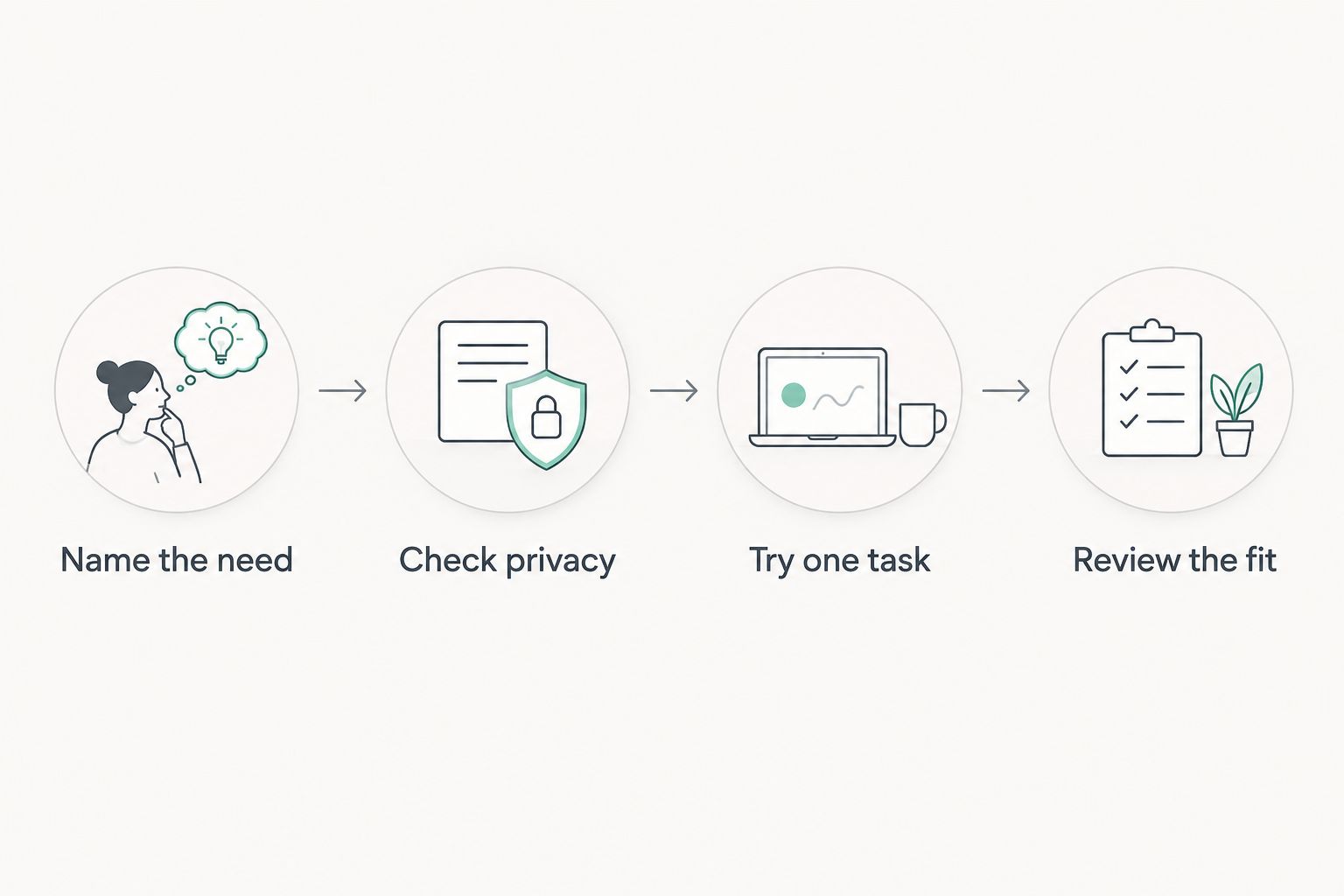
Use this sequence to narrow the decision. Start with one app for one purpose, rather than building a collection of overlapping tools.
- Name the need: Decide whether you want guided practice, routine support, mood records, emotional vocabulary, or anxiety exercises.
- Check privacy: Review data collection, sharing, deletion, and age requirements before recording sensitive details.
- Try one task: Choose a manageable action, such as a 2-minute check-in, as a personal starting limit rather than a treatment dose.
- Review the fit: After 7 days, ask whether the tool supports your goal or creates more pressure. This is a usability review, not a clinical test.
You can stop sooner if an app increases distress or makes checking your feelings feel compulsory. You do not owe a tool continued use because you started a streak or entered personal information.
For shared devices, consider who can see notifications and open the app. Review device access and notification previews alongside the app's own privacy settings.
How these apps are ranked
This 2026 ranking separates options by purpose, interaction style, and self-help limitations. Headspace is the default for guided mindfulness; the other apps win their distinct slots because they address different tasks, not because every reader needs meditation first.
Calmcharleston's mental health apps guide does not claim a clinical trial, head-to-head testing, or measured treatment outcomes. The recommendations distinguish publicly described app functions from the individualized assessment and support available through counseling.
Which mental health app should you choose?
Choose Headspace if you are undecided and specifically want guided mindfulness. Choose Finch for routines, Daylio for recording moods, How We Feel for describing emotions, or MindShift CBT for anxiety-focused exercises.
For your 2026 shortlist, remove any app whose main activity you already know you dislike. A detailed tracker is not a useful default if tracking makes you feel worse.
Calmcharleston is best for teens, adults, and seniors seeking individual counseling in Mount Pleasant and Charleston, rather than another self-help app. Its practice also offers couples and telehealth therapy; an app comparison cannot determine which care format fits your circumstances.
Explore counseling support
Individual, couples, and telehealth therapy for teens, adults, and seniors.
FAQ
What's the best mental health app for Gen Z in 2026?
Headspace is this guide's default for guided mindfulness, not for every mental health need. Finch fits routines, Daylio fits mood tracking, How We Feel fits emotional vocabulary, and MindShift CBT fits anxiety-focused exercises.
Is Finch better than Headspace?
Finch is the better fit for pet-based routine encouragement; Headspace is the better fit for guided meditation. Choose according to the activity you want rather than treating them as interchangeable.
Can a mental health app replace therapy?
A self-help app does not replace individualized assessment and treatment from a qualified professional. Seek professional support when symptoms persist, worsen, or interfere with daily life.
Are mood-tracking apps useful if I overthink everything?
Mood tracking is a poor fit when recording encourages more rumination or repeated checking. Stop or simplify the activity and discuss the pattern with a clinician if it is distressing.
Can teenagers use these mental health apps?
Teenagers should check each app's current age requirements and consent terms before signing up. Eligibility varies, and this shortlist is not confirmation that every app suits every age.
How do I choose a private mental health app?
Read the current privacy policy, data-sharing terms, deletion instructions, and device-access settings before entering sensitive information. Do not assume a consumer app handles information like your clinician's practice.
What should I do if I need help right now?
In the United States, call or text 988 for suicide or mental health crisis support. If there is immediate danger or a medical emergency, call 911; do not wait for an app exercise to help.
One last thing
An app can make progress easy to count without measuring what matters to you. Completing a check-in is not the same as sleeping better, reconnecting with someone, or feeling able to attend class.
Before you start, write down the real-life change you want to discuss or observe. Bring that goal—not just a streak—to a conversation with Calmcharleston or another qualified clinician.