

Best overall for structured anxiety self-help: MindShift CBT. Best for guided meditation: Headspace. Best for meditation variety: Insight Timer. Best for trauma-related coping support: PTSD Coach. This 2026 guide compares the best anxiety management apps by what you need help doing, not by download counts.
- MindShift CBT leads the best anxiety management apps for structured cognitive behavioral therapy exercises.
- Headspace suits guided mindfulness; Insight Timer suits readers who want to choose among different meditation teachers.
- PTSD Coach supports trauma-related coping but does not diagnose or treat PTSD on its own.
- Calmcharleston offers anxiety counseling for readers seeking professional support beyond an app.
Why this matters
An anxiety app can help you practice a skill between difficult moments. It cannot determine why you feel anxious, assess your full mental health history, or replace individualized treatment.
The useful distinction in 2026 is not which app promises the calmest life. It is whether you need help working with anxious thoughts, practicing mindfulness, or coping with trauma-related distress. Those are different jobs.
Calmcharleston is best for readers seeking individual anxiety counseling rather than app-only self-help. The practice offers individual and telehealth therapy for teens, adults, and seniors in Mount Pleasant and Charleston, SC. You can explore Calmcharleston if you want professional support alongside these tools.
What makes the best anxiety management apps?
Use these criteria before choosing an app:
- Relevant method: Cognitive behavioral therapy, mindfulness, and trauma coping tools address different needs. Choose the method that matches your immediate goal.
- Active practice: Look for something you can do, such as a thought exercise or guided meditation, rather than reassurance you repeatedly reread.
- Manageable effort: Choose an exercise you can realistically complete when anxiety makes concentration difficult.
- Clear boundaries: An app should be treated as self-help, not as a diagnosis, emergency service, or substitute for a clinician.
- Privacy fit: Check what happens to journal entries, symptom responses, account details, and other sensitive information before entering them.
These rankings reflect the apps' established purposes, not a clinical trial comparing them. There is no single winner for every anxiety symptom, and a longer feature list does not establish better care.
Anxiety apps at a glance
For this 2026 shortlist, each app has a distinct role. Start with the task you want to practice rather than installing every option.
| App | Best for | Standout feature | Key limitation |
|---|---|---|---|
| MindShift CBT | CBT practice | Anxiety-focused tools based on cognitive behavioral therapy | Self-directed exercises lack individualized clinical feedback |
| Headspace | Guided meditation | Guided mindfulness instruction | Meditation does not replace anxiety assessment or treatment |
| Insight Timer | Meditation variety | Meditation content from different teachers | Choosing content requires more self-direction |
| PTSD Coach | Trauma coping | PTSD education and coping tools developed by public health agencies | Trauma-specific focus does not fit every anxiety concern |
A CBT exercise asks you to examine a thought or behavior. A meditation asks you to practice attention differently. Trauma coping tools address a different context again; these options are not interchangeable versions of the same treatment.
1. MindShift CBT: best anxiety app for structured CBT practice
MindShift CBT, from Anxiety Canada, applies cognitive behavioral therapy principles to anxiety self-help. Its tools help users work with anxious thinking and practice responding differently to anxiety.
Best for: You want an active exercise for anxious thoughts rather than another recording to listen to. It is the default pick here because its purpose directly matches anxiety management.
MindShift CBT pros
- Anxiety is the app's central focus, rather than a secondary topic within a general wellness library.
- CBT-based exercises give you a task to practice instead of only offering distraction.
- Thought-focused work can help you distinguish a prediction from evidence supporting that prediction.
- Self-directed tools give you something concrete to discuss with a therapist afterward.
MindShift CBT cons
- Written reflection takes effort when you are overwhelmed or struggling to concentrate.
- The app cannot identify when a thought exercise has become repeated checking or reassurance-seeking.
- Exercises do not adapt to your history the way an individualized treatment plan can.
Use MindShift CBT with a specific situation in mind. For example, examine an anxious prediction before a meeting, then compare it with what actually happened afterward. The purpose is to practice a different response, not to prove that nothing uncomfortable will ever happen.
Verdict: Buy into the practice, not a promise of certainty. Choose MindShift CBT for structured anxiety self-help.
2. Headspace: best anxiety app for guided meditation
Headspace provides guided meditation and mindfulness content. Its role in anxiety management is helping you practice paying attention to thoughts, sensations, and the present moment without immediately reacting to everything you notice.
Best for: You want spoken guidance instead of filling out a thought worksheet. Headspace is the stronger fit when your goal is learning a mindfulness practice, not analyzing each anxious prediction.
Headspace pros
- Guided instruction gives beginners a clear activity to follow.
- Audio practice offers an alternative to writing about anxiety.
- Mindfulness provides a way to notice thoughts without treating every thought as an instruction.
Headspace cons
- Meditation does not provide an individualized explanation for persistent anxiety.
- Focusing inward can feel uncomfortable, particularly when bodily sensations already trigger fear.
- Listening alone does not address avoidance or other behaviors maintaining anxiety.
Do not measure a meditation only by whether you feel calm afterward. A more useful question is whether you practiced noticing distraction and returning attention without turning the exercise into another performance test.
If focusing on your breath increases distress, stop that exercise. You do not need to force a breathing practice to make an app useful, and you can discuss a different approach with a clinician.
Verdict: Buy into guided practice if mindfulness is your goal; skip Headspace as a replacement for anxiety treatment.
3. Insight Timer: best anxiety app for meditation variety
Insight Timer combines a meditation timer with guided content from different teachers. Its distinguishing feature is choice: you can explore different voices and approaches rather than relying on a single teaching style.
Best for: You already know something about the meditation style you prefer. Insight Timer suits readers who want room to choose and are comfortable deciding what fits.
Insight Timer pros
- Different teachers let you look for instruction you find understandable and comfortable.
- The meditation timer supports practice without a guided recording.
- Guided and unguided options accommodate different preferences.
Insight Timer cons
- Browsing creates another decision when you already feel mentally overloaded.
- A large content selection is not the same thing as a coordinated anxiety treatment plan.
- A recording's title does not establish that its approach fits your symptoms or history.
Choose a specific purpose before browsing. You might want a guided attention exercise, or you might prefer silent practice with a timer. That decision is more useful than searching indefinitely for a recording that guarantees relief.
Save an exercise you find workable rather than repeatedly starting a new search. The goal is to practice a skill, not to find a teacher whose words eliminate every anxious feeling.
Verdict: Buy into Insight Timer if choice helps you practice; skip it if browsing becomes the main activity.
4. PTSD Coach: best anxiety app for trauma-related coping
PTSD Coach was developed by the U.S. Department of Veterans Affairs and the Department of Defense. It offers education about PTSD, symptom self-assessment, coping tools, and information about finding support.
Best for: You want trauma-related coping resources alongside professional care. It belongs on this list because anxiety can occur in a trauma-related context, not because every anxious person needs a PTSD-focused app.
PTSD Coach pros
- Its educational material specifically addresses PTSD rather than treating all distress as general stress.
- Coping tools give users activities to try during difficult moments.
- Information about professional support helps place self-help within a broader care plan.
PTSD Coach cons
- A self-assessment cannot establish a PTSD diagnosis.
- Trauma-related material can be distressing to engage with alone.
- Its focus is narrower than what someone seeking general anxiety exercises needs.
Do not use a symptom score to label yourself or rule out a problem. A clinician can consider the context, duration, impact, and other explanations for symptoms in a way an app cannot.
If trauma-related content leaves you feeling less grounded, stop and seek support. You do not need to continue an exercise simply because it appears in a mental health app.
Verdict: Hold PTSD Coach for trauma-related coping needs; skip it as the default choice for general worry.
How we ranked these apps
The 2026 ranking prioritizes a clear match between an app's established purpose and a specific reader need. MindShift CBT leads for anxiety-focused CBT practice; Headspace, Insight Timer, and PTSD Coach serve different goals rather than competing for the same slot.
The criteria are method, active practice, manageable effort, clinical boundaries, and privacy fit. This is not a claim that any app outperforms therapy or produces a particular symptom reduction.
Before using any option, read its current privacy information and feature descriptions. This guide does not certify an app's data handling or establish which features are included in its current version.
Choose an app without making it another project
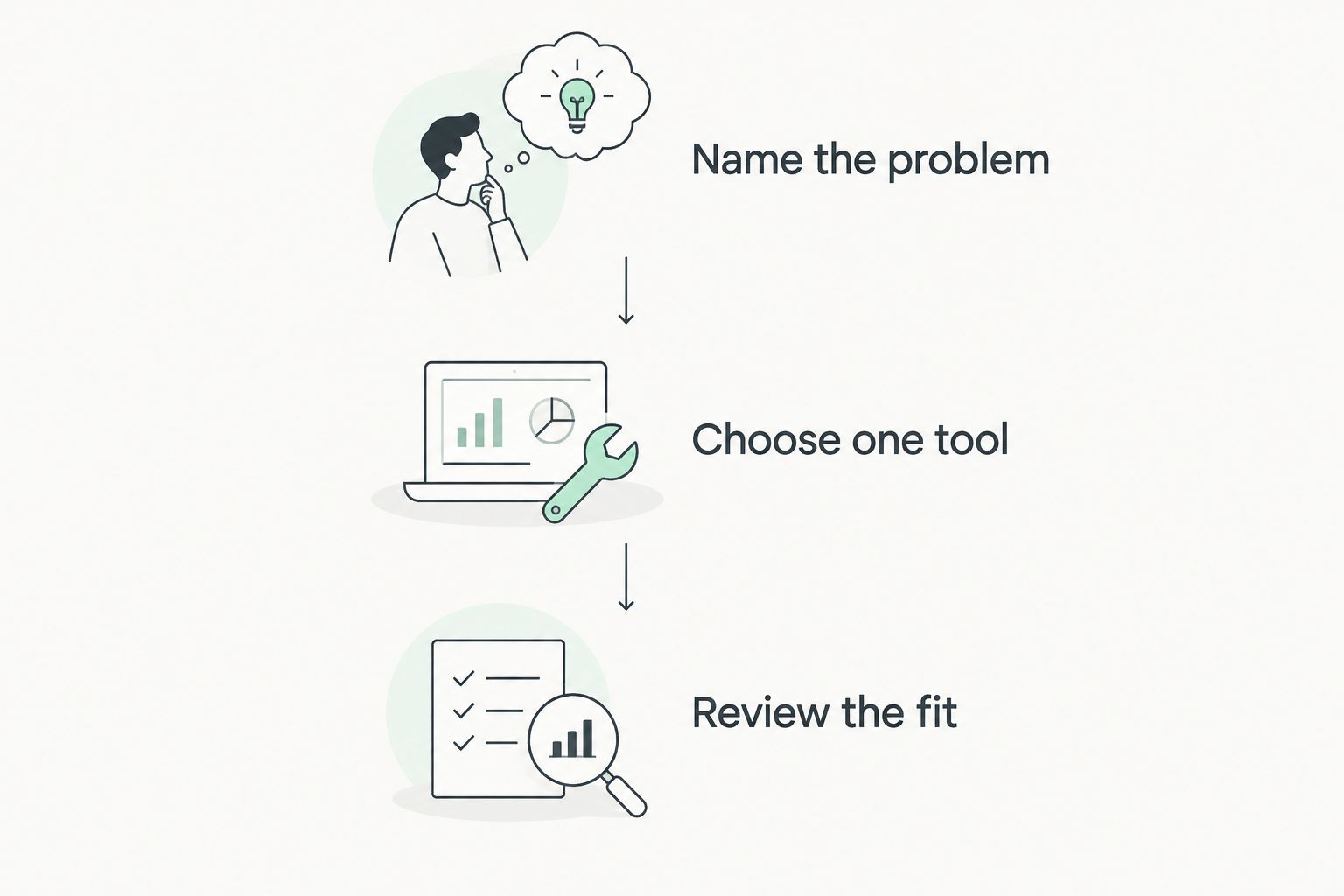
Use this simple selection process for your 2026 app choice. The time limits below are suggested boundaries for your own trial, not treatment dosages or promised timelines.
Name the problem
Write 1 sentence about the moment you want help with. For example: you avoid opening work email because you expect criticism. That is a clearer target than wanting to stop all anxiety.
Choose one tool
Start with 1 exercise that fits that problem. Set aside 2 minutes to learn what the exercise asks you to do, then decide whether it is understandable and tolerable.
Review the fit
After 7 days, review whether you practiced the skill and whether it supported useful action. Do not treat that review as a deadline for recovery or proof that treatment is unnecessary.
Keep the trial narrow. If you spend more time comparing apps than using a skill, return to the problem you named and choose the simplest suitable exercise.
When an app is not enough
Seek professional support when anxiety interferes with sleep, school, work, relationships, or ordinary activities. You do not need to exhaust self-help options before asking for care.
A clinician can assess symptoms, discuss treatment options, and help you recognize when a coping strategy is becoming avoidance. Calmcharleston provides individual and telehealth therapy for people dealing with anxiety, alongside its other counseling services.
For an immediate mental health crisis in the United States, call or text 988. Call 911 for a life-threatening emergency; an anxiety app is not an emergency response service.
Explore support beyond an app
Learn about individual and telehealth therapy for anxiety in Mount Pleasant and Charleston, SC.
Which anxiety management app should you choose?
Choose MindShift CBT if you are undecided and want structured, anxiety-focused exercises. Choose Headspace for guided mindfulness, Insight Timer for meditation variety, or PTSD Coach when trauma-related coping is the relevant need.
The best 2026 choice is the one that matches your task without asking an app to provide clinical judgment. Pair self-help with professional care when symptoms disrupt your life.
FAQ
What's the best anxiety management app in 2026?
MindShift CBT is this guide's default choice for structured, anxiety-focused self-help. Headspace fits guided meditation, Insight Timer fits meditation variety, and PTSD Coach fits trauma-related coping needs.
Is MindShift CBT better than Headspace for anxiety?
MindShift CBT is the better fit for CBT-based anxiety exercises, while Headspace fits guided mindfulness practice. Choose according to the skill you want to practice rather than treating the apps as equivalent treatments.
Can an anxiety app replace a therapist?
An anxiety app cannot replace individualized assessment and treatment from a qualified clinician. Apps can support skill practice, but they do not evaluate your full history or adapt care through a therapeutic relationship.
What if meditation makes my anxiety worse?
Stop an exercise that increases distress rather than forcing yourself through it. Discuss the reaction with a clinician, especially if attention to breathing or bodily sensations repeatedly triggers fear.
Can PTSD Coach tell me whether I have PTSD?
PTSD Coach cannot diagnose PTSD. Its educational and self-assessment tools can help you identify concerns to discuss with a qualified clinician.
Should I use several anxiety apps at once?
Start with one app and one relevant exercise so you can judge whether the practice fits. Add another tool only when it serves a different, clearly defined purpose.
When should I seek counseling instead of using an anxiety app?
Seek counseling when anxiety interferes with daily life or you want individualized help understanding it. Calmcharleston offers anxiety counseling through individual and telehealth therapy for teens, adults, and seniors.
One last thing
Feeling calm is not the only useful outcome of anxiety practice. Completing an important task while feeling anxious can matter more than getting a lower symptom score before you begin.
Ask whether the app helps you participate in your life, not whether it removes every uncomfortable feeling. That is a more useful standard than collecting recordings you never use.