

Best starting point: present-time orientation. Best for sensory focus: the 5-4-3-2-1 exercise. Best for feeling disconnected from your body: feet-and-chair contact. These are practical picks among the best grounding techniques for dissociation, not a clinical ranking; this 2026 guide explains how to try each without forcing yourself through distress.
- The best grounding techniques for dissociation redirect attention toward your present surroundings without increasing distress.
- Start with present-time orientation; use fewer sensory steps when a longer exercise feels overwhelming.
- For PTSD grounding, keep your eyes open and stop any technique that intensifies flashbacks or disconnection.
- Calmcharleston offers individual counseling for teens, adults, and seniors dealing with trauma and other mental health concerns.
Why this matters
Dissociation can involve feeling detached from yourself, disconnected from your surroundings, or as though things are unreal. Grounding gives your attention a concrete present-day reference. It does not diagnose the cause or replace treatment for PTSD.
The best exercise is one you can tolerate, not the one you can finish perfectly. A texture, sound, or body sensation that helps someone else can be uncomfortable for you. Stop or switch when an exercise increases distress.
Calmcharleston offers individual counseling for teens, adults, and seniors dealing with trauma in Mount Pleasant and Charleston, SC. If dissociation interrupts daily life, you can explore Calmcharleston rather than relying only on grounding techniques.
What makes the best grounding techniques for dissociation
Use these criteria to choose your starting point in 2026:
- Present-day focus: The exercise directs attention toward something happening now, rather than asking you to revisit a memory.
- Personal tolerability: You can change or stop the exercise without treating discomfort as something to overcome.
- Low mental demand: The steps remain manageable when concentration is difficult.
- Practical access: You can use the exercise where you are, without special equipment.
- Choice and control: You decide whether to use movement, sensation, words, or another person's help.
No technique wins every category. Start with the simplest option that suits your surroundings, then keep an alternative that uses a different kind of attention.
Grounding techniques at a glance
| Technique | Best for | Standout feature | Key limitation |
|---|---|---|---|
| Present-time orientation | Confusion about where or when you are | Uses concrete facts about the current setting | Repeating facts can feel mechanical |
| 5-4-3-2-1 sensory inventory | Scattered attention | Provides a structured sensory sequence | Several steps can overwhelm |
| Feet-and-chair contact | Feeling physically disconnected | Uses existing points of support | Body attention can increase discomfort |
| Neutral object description | Intrusive images crowding attention | Gives attention one external task | Some objects carry unwanted associations |
| Gentle purposeful movement | Feeling stuck or frozen | Adds a deliberate physical action | Movement is unsuitable when balance is impaired |
| Familiar sound focus | Body-focused exercises feeling uncomfortable | Uses an external listening target | Certain sounds can be triggering |
| Trusted-person orientation | Difficulty grounding alone | Adds calm, consensual support | Depends on another person's availability |
1. Present-time orientation: best for place-and-time confusion
Present-time orientation means naming facts about your current surroundings. Keep your eyes open if that feels more comfortable, look around, and describe where you are without requiring yourself to feel calm.
Try: “I am in my living room. It is 2026. The window is beside the couch.” Use details you can verify. Say that you are safe only when your actual circumstances support that statement.
Present-time orientation pros:
- Requires no equipment or preparation.
- Can be spoken aloud or silently.
- Connects words with visible present-day details.
Present-time orientation cons:
- Words alone do not always hold attention.
- Repeated reassurance can feel unconvincing during intense distress.
Best for: Moments when the past feels close or your surroundings feel unfamiliar. Add a visible detail, such as the door's location, instead of repeatedly testing yourself on the date.
Verdict: Skip statements that feel false; use concrete orientation facts you can verify.
2. The 5-4-3-2-1 exercise: best for scattered attention
The 5-4-3-2-1 exercise directs attention toward five things you see, four things you feel, three things you hear, two things you smell, and one thing you taste. Treat the sequence as a guide, not a test.
Start with neutral surroundings: a wall, a book, or a patch of light. If smell or taste brings up unwanted associations, leave those senses out. Naming three visible objects is a valid alternative to completing the full sequence.
The 5-4-3-2-1 exercise pros:
- Provides a clear sequence when you want structure.
- Offers several external attention targets.
- Adapts to the senses you find tolerable.
The 5-4-3-2-1 exercise cons:
- Counting can become frustrating during strong dissociation.
- Sensory attention can bring unwanted reminders into focus.
Best for: Scattered attention when following a sequence feels manageable. There is no benefit in struggling to identify a smell simply to finish the exercise.
Verdict: Skip the full sequence when it adds pressure; use a shorter sensory inventory instead.
3. Feet-and-chair contact: best for physical disconnection
Feet-and-chair grounding brings attention to support that is already present. If you are seated comfortably, notice two contact points: your feet against the floor and your back against the chair.
Describe the contact without changing it: firm, soft, warm, or cool. You do not need to scan your whole body, close your eyes, or take deep breaths. If physical sensations become uncomfortable, return attention to an object across the room.
Feet-and-chair contact pros:
- Works without adding another task or object.
- Keeps attention on a small, defined area.
- Can be used discreetly while seated.
Feet-and-chair contact cons:
- Body awareness can intensify discomfort for some people.
- Pain or an uncomfortable seat can distract from the exercise.
Best for: Feeling floaty or physically distant when noticing support feels tolerable. Change your position for comfort before beginning.
Verdict: Skip body-focused grounding when it increases detachment or distress; choose an external focus.
4. Neutral object description: best for intrusive imagery
Choose an ordinary object and describe its observable features. A plain cup, notebook, or key can give your attention a specific task without asking you to analyze the intrusive image.
Name the object's shape, material, color, and visible edges. Keep the description literal: “The notebook has a blue cover and a bent corner.” You can look without touching if texture feels unpleasant.
Neutral object description pros:
- Uses a single, steady attention target.
- Works without breath or body monitoring.
- Can remain entirely visual.
Neutral object description cons:
- An object can carry unexpected personal associations.
- Searching for the perfect object adds unnecessary effort.
Best for: Times when mental images crowd out your surroundings but a simple description remains possible. The goal is contact with the present, not an argument with the memory.
Verdict: Skip objects with upsetting associations; choose something ordinary and easy to describe.
5. Gentle purposeful movement: best for feeling stuck
Purposeful movement means choosing a small action and noticing what happens. Open and close your hands, press your palms together gently, or move your feet while seated.
Keep the movement within your physical abilities. This is not a workout or a demand to push through a freeze response. If you feel dizzy, unsteady, or disconnected from your position, stay seated rather than walking around.
Gentle purposeful movement pros:
- Creates a clear action you choose to begin and end.
- Offers an alternative to sitting completely still.
- Can be adapted for comfort and mobility.
Gentle purposeful movement cons:
- Pain or mobility limitations restrict some movements.
- Standing or walking adds risk when balance is impaired.
Best for: Feeling stuck when a small, comfortable movement feels accessible. Notice the action itself rather than judging whether you feel sufficiently grounded afterward.
Verdict: Skip movements that hurt or compromise balance; choose a seated alternative or another technique.
6. Familiar sound focus: best for avoiding body-focused exercises
Sound grounding uses a tolerable sound as an external reference. Listen to a fan, a clock, or another predictable sound in your surroundings, then describe what you hear.
Notice whether the sound is steady or changing, near or distant. Keep the volume comfortable and avoid blocking your awareness of traffic or other hazards. If sound becomes irritating or brings up a memory, switch to a visual target.
Familiar sound focus pros:
- Does not require monitoring bodily sensations.
- Can use sounds already present.
- Provides a focus without a complicated sequence.
Familiar sound focus cons:
- Familiar sounds can still have unwanted associations.
- Busy or noisy settings make listening harder.
Best for: Times when breathing exercises or body awareness feel uncomfortable, but listening remains tolerable. Music is optional; an ordinary background sound is enough.
Verdict: Skip sounds that startle or overwhelm you; choose a quieter external reference.
7. Trusted-person orientation: best for grounding with support
A trusted person can help you notice your surroundings when doing it alone feels difficult. Ask for a calm voice and simple observations rather than a stream of questions.
You might say: “Please remind me where we are and help me name something in the room.” Discuss preferences when you feel settled, including whether touch is welcome. Support should not involve unexpected touching, demands for eye contact, or pressure to explain trauma.
Trusted-person orientation pros:
- Reduces the burden of remembering every step.
- Allows someone to offer practical help.
- Can follow preferences agreed on beforehand.
Trusted-person orientation cons:
- A trusted person is not always available.
- Too many instructions or questions can increase distress.
Best for: Episodes when you want support and can identify someone who respects your boundaries. Agree on a simple request instead of expecting that person to guess.
Verdict: Skip help from anyone who ignores your boundaries; seek a different support person.
How these techniques are ranked
This 2026 guide orders techniques by practical starting point and distinct use case—not by proven superiority. Present-time orientation comes first because it requires no equipment and focuses on verifiable surroundings.
The criteria are tolerability, mental demand, access, present-day focus, and personal control. A lower-ranked technique is the better choice when it suits your needs more closely. None is presented as a treatment for the underlying cause of dissociation.
Which grounding technique should you choose?
Start with present-time orientation, then choose one alternative that uses a different focus. Pairing orientation with object description gives you another external option; pairing it with feet-and-chair contact adds a body-based option if that feels comfortable.
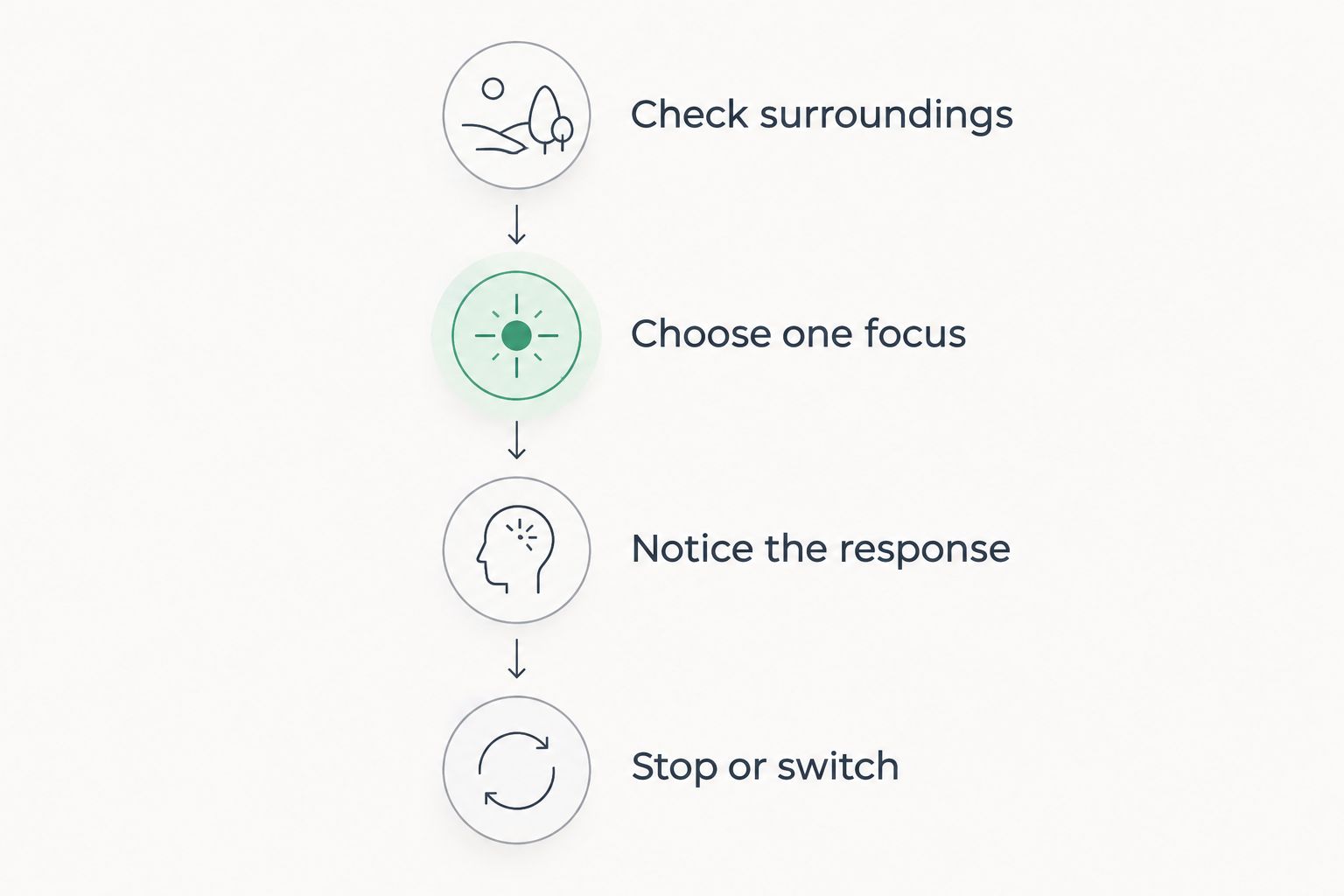
Use this short decision process:
- Check surroundings: Move away from immediate hazards before starting an exercise.
- Choose one focus: Pick words, sight, contact, movement, or sound.
- Notice the response: Continue only while the exercise remains tolerable.
- Stop or switch: Change the task if distress or disconnection increases.
Practicing a tolerable exercise when you feel settled helps you learn its steps without the pressure of an episode. Keep instructions somewhere easy to find rather than assembling a long list you must remember.
Grounding techniques are coping tools, not a substitute for assessment. For support beyond grounding techniques, Calmcharleston offers individual counseling and telehealth therapy for people dealing with trauma and other concerns. Ask about the clinician's approach and whether it fits your needs.
Explore counseling for trauma
Learn about counseling for teens, adults, and seniors in Mount Pleasant and Charleston, SC.
FAQ
What's the best grounding technique for dissociation?
Present-time orientation is a practical starting point: name where you are and describe visible details. It is not universally best; switch to another tolerable focus if words do not help you engage with your surroundings.
Is the 5-4-3-2-1 method better than breathing for PTSD?
Neither exercise is universally better for PTSD. The 5-4-3-2-1 method offers sensory targets, while breathing directs attention inward; choose the focus that does not intensify distress.
Can grounding make dissociation feel worse?
Yes, some grounding exercises can increase distress or disconnection. Stop an exercise that worsens symptoms, and discuss repeated difficulties with a qualified mental health professional.
Should I use ice or painful sensations to ground myself?
Avoid painful or extreme sensations as grounding tools. Choose a comfortable texture, a visible object, or another neutral present-day reference instead.
What should I say to someone who is dissociating?
Use a calm voice, identify yourself, and ask whether the person wants help noticing their surroundings. Offer a simple choice and ask permission before touching them.
Does grounding treat PTSD on its own?
Grounding is a coping tool, not a standalone treatment for PTSD. Recurrent dissociation, lost time, or disruption to daily life warrants professional assessment.
When should I get urgent help for dissociation?
Get urgent help when you cannot stay safe, have a serious injury, or develop sudden unexplained confusion. In the United States in 2026, call 911 for an emergency; call or text 988 for suicide or mental health crisis support.
One last thing
Your backup technique should differ from your first choice. If body attention feels uncomfortable, another body-focused exercise repeats the same obstacle; keep an external option, such as describing a neutral object.
For your 2026 grounding plan, write down what helps and what to avoid. That small distinction gives you and a support person clearer instructions than a long checklist of exercises.